
Best Calendar Clocks for Seniors With Dementia
As an Amazon Associate, I earn from qualifying purchases
When someone you care about is living with dementia, even simple things like knowing the day or time can become confusing. You and I often take that for granted, but for seniors dealing with memory loss, it can create daily stress and anxiety.
That’s exactly where calendar clocks can make a real difference. These clocks don’t just show the time. Instead, they clearly display the full day, date, and even parts of the day like morning or evening. Because of that, they help bring a sense of structure and reassurance.
Now, you might be wondering which one actually works best. Not all calendar clocks are designed with seniors in mind, and some are harder to read than they should be. That’s why I put this guide together for you.
In this post, you’ll find the best calendar clocks for dementia patients that are simple, easy to understand, and truly helpful in everyday life.
Here Are the Best Calendar Clocks For Dementia Patients
1. Roxicosly Store Clock with Day and Date for Elderly


Roxicosly Store Clock with Day and Date for Elderly is designed to reduce confusion around time, especially for seniors with dementia. It clearly displays the full day, date, and time, which helps when someone wakes up from a nap unsure if it is morning or evening.
The screen is easy to set up and offers several display options. This flexibility matters because not every senior processes information the same way. In one case, the caregiver preferred one layout, while the mother chose a different one that felt clearer to her. That personal choice made the clock more useful.
It does not use backup batteries. However, it retains time and settings when briefly unplugged. The clock also includes alarm features, though some seniors may not need them. Overall, it is a simple tool that supports daily orientation and peace of mind.
Who Is This Product Suitable For
This clock is suitable for seniors with dementia who wake from naps confused about AM or PM. It also fits families who want customizable display options so their loved one can choose the layout that makes the most sense to them.
Pros: Customizable display, easy setup, clear day and date view.
Cons: No backup battery, alarm may go unused.
2. Soobest 12” Dementia Digital Clock for Seniors
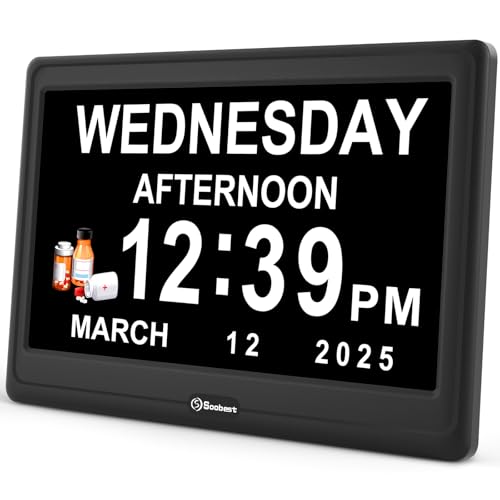
Soobest 12” Dementia Digital Clock for Seniors is designed specifically for seniors with dementia and cognitive impairment. It clearly displays the full date, exact time, and time of day in large, easy-to-read letters. This helps reduce confusion about whether it is morning, afternoon, or night.
Setup is simple and straightforward. The screen is bright, high quality, and large enough to see from across the room without being overwhelming. It has a clean, modern look that blends well into most rooms.
The clock includes medication alarms, which support daily routines and dosing schedules. Caregivers can point to the display to explain the day and time, making communication easier. A built-in backup battery keeps settings saved during power outages. Families report that it improves independence and provides peace of mind.
Who Is This Product Suitable For?
This clock is ideal for seniors with dementia or cognitive impairment who struggle with time confusion, daily orientation, or medication reminders. It also suits families who want a simple tool to support routines and reduce repeated questions.
Pros: Large clear display; medication alarms; backup battery; easy setup
Cons: Some may prefer the larger screen size option
3. Véfaîî 11.5 Inch Extra Large Digital Clock with 19 Alarms

Véfaîî 11.5 Inch Extra Large Digital Clock with 19 Alarms is designed with seniors who have dementia in mind. The large, bright 11.5-inch display can be seen clearly from across the room, which helps reduce confusion about time and date. It clearly spells out the day of the week and, depending on the screen, shows either an abbreviated or fully spelled-out month.
It offers multiple display styles, including a combined analog and digital clock, which many seniors prefer. The menu is simple to navigate, making setup manageable for caregivers. Importantly, the clock remembers its settings after a power failure.
The 19 programmable alarms are helpful for daily routines. You can set reminders for meals, and it plays a song for a chosen duration. There is no option to change the sound. It runs on a dedicated power supply, not USB. A manual night mode allows screen dimming at set times.
Who Is This Product Suitable For
This clock is ideal for seniors with dementia who struggle to remember the day, date, or daily schedule. It works especially well for those who benefit from clear, large displays and routine-based reminders for meals and activities.
Pros: Large, clear display; reliable memory backup; easy-to-set meal reminders.
Cons: No choice of alarm sound; night mode is not automatic; not USB powered.
4. American Lifetime New 2026 Dementia Clock

American Lifetime New 2026 Dementia Clock is a thoughtful and practical tool for seniors living with dementia or Alzheimer’s. The 8-inch model works especially well in smaller rooms and does not take up much space. It is bright, clear, and easy to read from across the room.
The display helps seniors stay oriented to the correct day and time. This can reduce confusion and daily anxiety. The brightness feels balanced during the day. At night, it appears to adjust automatically so it remains visible without disturbing sleep.
Setup is simple and quick. The clock can be placed on a table or mounted on the wall, which gives flexibility. It also includes a pill reminder feature, though not every family may need it.
Overall, the 8-inch size suits many homes better than the larger 15-inch option, which may feel oversized.
Who Is This Product Suitable For?
This clock is suitable for seniors with dementia or Alzheimer’s who need help staying oriented to time and day. It is ideal for someone living in a bedroom where space is limited but visibility from across the room is important.
Pros: Bright, easy to read, simple setup, good 8-inch size, wall-mount option
Cons: Larger 15-inch size may be too big for some rooms
Buyer’s Guide: Choosing The Best Calendar Clocks For Dementia Patients
Caring for someone with dementia changes how you think about everyday tools. A simple clock, something you and I barely notice, can become confusing or even distressing for a senior with memory loss. That is why calendar clocks are designed differently. They do more than show time. They help restore a sense of structure, safety, and calm.
Let’s walk through what really matters so you can choose the right one with confidence.
Why Seniors With Dementia Need A Different Type Of Clock
Dementia affects how a person understands time, sequence, and even basic daily routines. A traditional analog or digital clock only shows numbers. But for someone with dementia, those numbers often lose meaning.
For example, a person may not know if it is morning or evening. They may wake up at 2 a.m. and think it is time for breakfast. This confusion can lead to anxiety, poor sleep, and even wandering.
Calendar clocks solve this by showing clear, full information. Instead of just “7:00,” they display “Monday Morning 7:00 AM.” This simple addition can make a big difference.
Research has shown that structured visual cues can support orientation in dementia patients (National Institute on Aging study on cognitive support). That is exactly what these clocks are designed to do.
How To Use It And Where To Place It
A calendar clock only works well if it is visible and easy to read.
Place the clock in areas where the person spends most of their time. This usually means the bedroom and living room. If possible, use more than one clock in the home so the person does not have to search for it.
Position it at eye level. Avoid placing it too high or too low. The display should be visible from across the room without straining.
Also, make sure the lighting is good. Even the best clock will not help if it is hard to see. If the person wakes up at night often, placing one near the bed can reduce confusion and anxiety.
Consistency matters. Try not to move the clock once placed. Familiar placement helps reinforce memory.
Things To Look For When Buying
Not all calendar clocks are the same. Some are helpful, while others can still be confusing.
First, look for a large, clear display. The text should be bold and easy to read from a distance. Avoid cluttered screens.
Second, the wording should be simple. Phrases like “Morning,” “Afternoon,” “Evening,” and “Night” are easier to understand than just AM or PM.
Third, consider brightness adjustment. Seniors are sensitive to glare, especially at night. A dimmable screen is important.
Fourth, choose a non-abbreviated display. Full words like “Wednesday” instead of “Wed” reduce confusion.
Fifth, automatic time setting is helpful. Some clocks adjust for daylight saving time, which saves you from resetting it.
Lastly, check for power backup. A battery backup ensures the clock continues working during power outages.
How It Helps And Safety Considerations
A good calendar clock does more than tell time. It supports independence.
When a person knows the time of day, they are less likely to feel lost or anxious. It helps them follow routines like meals, medication, and sleep.
This can also reduce caregiver stress. You will spend less time answering repeated questions like “What time is it?” or “Is it morning yet?”
There are safety benefits too. Disorientation can lead to wandering or unsafe actions. Clear time cues reduce that risk.
According to Alzheimer’s research, maintaining daily structure can improve quality of life and reduce behavioral symptoms (Alzheimer’s Association daily routine guidance).
However, avoid overly complex devices. Too many features can overwhelm the user. Keep it simple and focused.
Tips For Caregivers
Start by introducing the clock slowly. Show it and explain what it displays. Repeat this over a few days.
Use it as part of daily conversation. For example, say, “It’s Monday morning, time for breakfast,” while pointing to the clock. This reinforces understanding.
Keep routines consistent. The clock works best when paired with predictable daily habits.
Check the settings occasionally. Make sure the time and date are correct, especially after power interruptions.
If your loved one ignores the clock at first, do not worry. It takes time. Gentle repetition is key.
My Quick Advice
If you are choosing a calendar clock, focus on clarity over features. A simple, large display with full words will always be more helpful than a fancy device with too many options.
From experience, the biggest benefit comes when the clock becomes part of a routine. It is not just about buying the right product. It is about how you use it daily.
Place it where it is naturally seen. Refer to it often. Keep everything consistent.
Most importantly, think from the perspective of the person using it. If something looks even slightly confusing to you, it will likely be much harder for them.
A good calendar clock will not solve everything. But it can bring small moments of clarity. And in dementia care, those small moments matter more than you might expect.
