
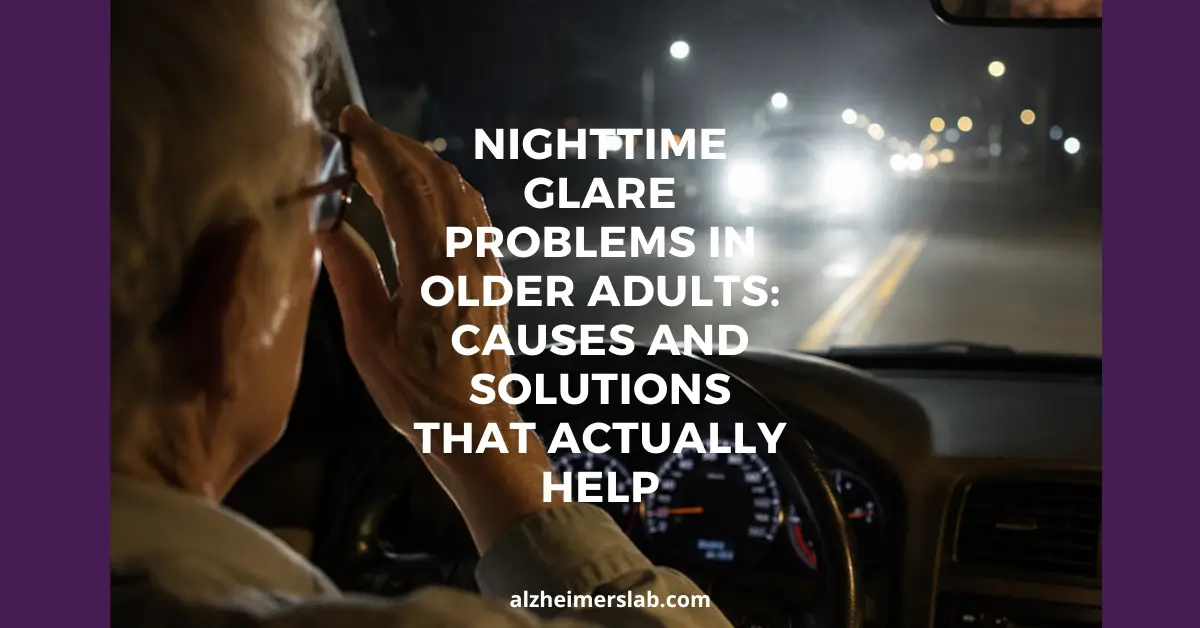
Nighttime Glare Problems in Older Adults: Causes and Solutions That Actually Help
Driving at night in your 30s probably felt routine. You could handle dark roads, bright headlights, rain, and traffic without thinking much about it. But somewhere in your 50s or 60s, something changed. The same road suddenly feels harsher. Oncoming headlights seem painfully bright. Streetlights leave streaks across your vision. And after one car passes with high beams on, it can feel like your eyes need several seconds to recover.
If this sounds familiar, you are far from alone.
Older adults face a much higher risk of fatal nighttime crashes per mile driven, even though they usually drive less than younger adults. The reason is not simply “bad driving.” In many cases, the real issue is how aging changes the eye’s ability to handle darkness, contrast, and glare. Resource: Center for Injury Research and Policy, Columbus, OH, United States
The good news is that nighttime glare is not something you just have to accept. Once you understand what is happening inside your eyes, many of these problems become manageable. Some solutions are surprisingly simple, while others can dramatically improve your vision and confidence behind the wheel.
By the end of this article, you will understand why nighttime glare gets worse with age, what conditions contribute to it, and what you can realistically do to improve the situation.
It’s Not Just You Getting Older
Many people assume nighttime glare is simply part of “getting old.” While aging absolutely plays a role, there are specific physical changes happening in the eye that make bright lights harder to process.
First, it helps to understand what glare actually is.
There are two main types of glare older adults experience at night.
Discomfort Glare
This is the type that feels irritating or painful. Bright headlights or LED streetlights may make you squint or feel strained, but you can still technically see the road.
It is unpleasant, but not always dangerous.
Disability Glare
This is the more serious type.
Disability glare happens when bright light temporarily reduces your ability to see clearly. For a few seconds after an oncoming car passes, your vision may seem washed out, dark, or blurry. During that short period, your brain struggles to process details like lane markings, pedestrians, or road signs.
That temporary loss of visibility is what makes nighttime glare dangerous.
The problem becomes worse because modern headlights are far brighter than older halogen lights. High-intensity-discharge (HID) headlights and many newer LED systems produce extremely intense white-blue light. Older eyes are far less capable of filtering and adapting to this kind of brightness.
In simple terms, your eyes are dealing with more challenging light conditions at the exact stage of life when they become less capable of handling them.
Here’s What’s Actually Happening Inside Your Eyes
The interesting thing about nighttime glare is that it usually does not come from one single problem. Instead, several age-related changes stack together over time.
Think of it like multiple small issues combining into one frustrating experience.
Cause #1: Your Pupil Isn’t Opening Up Like It Used To
When you walk into a dark room, your pupils naturally widen so more light can enter the eye. This helps you see in low-light conditions.
But as you age, your pupils gradually lose some of their ability to expand fully. This condition is called senile miosis.
In older adults, the pupil’s maximum size may become only a fraction of what it was in younger years. That means significantly less light reaches the retina during nighttime driving.
You can think of it like using a camera with the aperture stuck partially closed. The scene becomes darker and harder to process.
This reduced light intake forces your eyes and brain to work much harder at night. Even moderate glare from headlights can overwhelm the visual system because the eye is already struggling to gather enough useful light.
The result is reduced contrast, slower reaction time, and more visual fatigue.
Research source: The Aging Eye, NIH/NCBI
Cause #2: Your Lens Is Yellowing and Scattering Light
Inside your eye sits a clear structure called the crystalline lens. Its job is to focus incoming light onto the retina.
When you are younger, that lens stays relatively transparent. But with age, it gradually becomes thicker, yellower, and less clear.
This change affects vision in two major ways.
First, the lens absorbs more light, meaning less usable light reaches the retina. Second, it begins scattering light internally.
That scattering effect is a major reason headlights appear to “bloom” or spread across your vision instead of staying sharp and defined.
Instead of seeing a clean point of light, your brain sees haze, halos, and glare.
This is why many older adults describe nighttime headlights as looking fuzzy, smeared, or starburst-like.
Modern LED and HID headlights make this even more noticeable because blue-white light scatters more aggressively inside aging eyes.
Research source: Aging, Light Sensitivity and Circadian Health, PMC
Cause #3: Your Eyes Recover More Slowly After Bright Light
When bright light hits the eye, your visual system needs time to recover afterward. This process is called dark adaptation.
In younger people, recovery happens fairly quickly. But aging slows this entire process down.
So when a bright car passes at night, your eyes may take longer to return to normal vision afterward.
This explains why some older drivers feel temporarily blind for several seconds after facing headlights.
Those few seconds matter more than people realize.
At highway speed, a car can travel hundreds of feet during a brief period of reduced visibility. That is why nighttime glare feels not only uncomfortable but also stressful and dangerous.
Many adults blame themselves for becoming “less confident” drivers, when in reality their visual recovery speed has physically changed.
Research source: Vision Through Healthy Aging Eyes, PubMed
Cause #4: Cataracts — The Big One
If there is one major reason nighttime glare suddenly becomes severe after age 60, it is cataracts.
A cataract happens when the eye’s natural lens becomes cloudy.
This cloudiness scatters incoming light in every direction, which dramatically increases glare sensitivity. Headlights, traffic lights, and even reflective road signs can start looking overwhelming.
Many people do not realize how much cataracts are affecting them because the changes happen gradually. You slowly adapt over time without noticing how much your nighttime vision has worsened.
One common sign is avoiding driving after dark because it feels exhausting or stressful.
Another sign is feeling like everyone else’s headlights are “too bright,” even when they are technically normal.
Cataracts are extremely common in older adults. In fact, they are one of the most frequent causes of nighttime driving difficulty after age 60.
The important thing to understand is that cataracts are highly treatable.
Cause #5: Other Eye Conditions Can Make Glare Worse
Several other age-related eye conditions can amplify nighttime glare problems.
Glaucoma
Glaucoma damages the optic nerve and often reduces peripheral vision and contrast sensitivity. This makes it harder to distinguish objects in low-light conditions.
Age-Related Macular Degeneration (AMD)
AMD affects the central part of vision responsible for detail and sharpness. Even mild glare can feel more disruptive because the retina already struggles to process fine detail.
These conditions do not always cause glare directly. Instead, they reduce the eye’s overall visual performance, making glare harder to tolerate.
That is why nighttime vision problems are often caused by multiple overlapping factors rather than one single issue.
So What Can You Actually Do?
The encouraging part is that many nighttime glare problems can improve significantly with the right strategies.
Some solutions are simple and inexpensive. Others involve medical treatment. The best approach depends on what is causing your glare in the first place.
Let’s go through them from easiest to most involved.
Solution #1: Anti-Reflective (AR) Coated Lenses
One of the simplest improvements you can make is adding anti-reflective coating to your glasses.
AR coatings reduce reflections bouncing around inside the lens itself. That means less scattered light reaches your eye.
For nighttime driving, this often translates into:
- Less halo around headlights
- Better contrast
- Sharper road visibility
- Reduced eye strain
Research published in the Journal of Cataract & Refractive Surgery found that anti-glare coatings improved visual acuity and contrast sensitivity in many participants with age-related eye conditions.
The key point here is that AR coating is not just cosmetic. For older adults, it can make a meaningful functional difference at night.
If you already wear prescription glasses, ask your optometrist whether your current lenses include high-quality anti-reflective coating. Older coatings can wear down over time.
Solution #2: Tinted Lenses — Understanding the Yellow vs. Amber Debate
You have probably seen yellow-tinted “night driving glasses” advertised online.
Some people swear by them. Others say they do nothing.
The truth is more nuanced.
Amber-tinted lenses can help certain older adults by filtering shorter blue wavelengths of light, which are often responsible for harsh glare and light scatter.
For people with cataracts or increased intraocular scatter, amber lenses may improve contrast and reduce visual discomfort.
However, there is a tradeoff.
Tinted lenses also reduce total light entering the eye. That means they can sometimes make already-dark roads appear even darker.
This is why results vary so much from person to person.
In many cases, the best combination is:
- Mild tint for wavelength filtering
- Anti-reflective coating for reflection control
Using only one approach often solves only part of the problem.
Before spending money on heavily marketed nighttime glasses online, it is smarter to discuss lens options with an eye care professional who understands your specific eye condition.
Solution #3: Cataract Surgery Can Be Life-Changing
For many older adults, cataract surgery becomes the turning point.
People often describe the experience the same way:
“It felt like someone switched the world back to HD.”
That description is surprisingly accurate.
During cataract surgery, the cloudy natural lens is replaced with a clear artificial intraocular lens (IOL). This dramatically reduces internal light scatter and improves contrast sensitivity.
Many newer IOLs also include blue-light filtering technology. These lenses contain a subtle yellow tint designed to reduce harsh blue wavelengths from headlights, LED lighting, and digital screens.
For people struggling with nighttime glare, cataract surgery often produces one of the biggest quality-of-life improvements possible.
Importantly, modern cataract surgery is extremely common and generally very safe.
If nighttime driving has become consistently difficult, exhausting, or frightening, it may be worth asking your eye doctor whether cataracts are contributing more than you realize.
Solution #4: Practical Driving Habits Matter More Than People Think
Some older adults feel embarrassed about changing their driving habits.
They should not.
In reality, adapting to changing vision is smart self-regulation, not weakness.
Many experienced older drivers naturally develop strategies that reduce risk without giving up independence completely.
Helpful habits include:
- Avoid driving during heavy nighttime traffic
- Limit long nighttime trips
- Choose familiar routes
- Avoid poorly lit roads when possible
- Reduce speed slightly at night
Small practical adjustments inside the car also help more than people expect.
Keep Your Windshield Extremely Clean
Tiny smudges and dust particles scatter incoming light and worsen glare dramatically.
Clean both the outside and inside of the windshield regularly.
Dim Dashboard Brightness
An overly bright dashboard reduces your eye’s ability to stay adapted to darkness.
Lowering interior brightness can improve contrast outside the vehicle.
Use the Night Setting on Your Rearview Mirror
Many people forget this feature exists. It can significantly reduce harsh reflection from cars behind you.
Look Slightly Right of Oncoming Headlights
Instead of staring directly at bright headlights, focus slightly toward the right edge of your lane. This reduces temporary blindness while still helping you stay oriented.
Seniors with glare problem can try these calender clocks that are easy to read at home.
Solution #5: Get Your Eyes Checked — And Ask the Right Questions
This may sound obvious, but many older adults are not getting the right type of vision assessment for nighttime problems.
Standard eye exams often happen under bright clinical lighting. Those tests measure sharpness in ideal conditions, not how your eyes perform in darkness or glare.
That means you can technically “pass” a vision test while still struggling badly at night.
Specialized low-light or mesopic testing provides a much better picture of nighttime visual performance. Some clinics also offer glare sensitivity testing.
Most people never ask about these evaluations because they do not know they exist.
If nighttime glare is becoming a real issue, ask your eye doctor specifically about:
- Contrast sensitivity testing
- Glare sensitivity testing
- Cataract progression
- Night-driving vision assessment
Research suggests these low-light tests provide a more accurate understanding of real-world nighttime driving performance in older adults.
Research source: Nighttime Driving in Older Adults, IOVS/ARVO
A Quick Word to Families
If you are concerned about a parent’s nighttime driving, the conversation can feel sensitive.
Most older adults do not respond well to being told they are “too old to drive.” Understandably, that can feel insulting or threatening.
A better approach is focusing on safety and comfort instead of age.
You might say:
“I noticed the headlights seem really harsh lately. Have you talked to your eye doctor about it?”
That keeps the conversation supportive rather than confrontational.
It also helps to ride with them occasionally at night. Pay attention to whether they already avoid highways, heavy traffic, or nighttime trips. Many older adults quietly self-restrict long before they openly admit driving feels difficult.
That behavior often shows awareness, not denial.
Your Eyes Aren’t Failing You — They Just Need Some Help
Nighttime glare is incredibly common as you get older, but that does not mean you are helpless against it. Aging changes how your pupils, lenses, and retina process light, especially under difficult nighttime conditions. Add cataracts or other eye conditions into the mix, and even ordinary headlights can start feeling overwhelming.
The most important steps are often the simplest: schedule a thorough eye exam, ask specifically about glare sensitivity, and explore practical solutions like anti-reflective lenses or cataract treatment if needed. For many people, even small changes lead to a huge improvement in nighttime comfort and confidence.
