
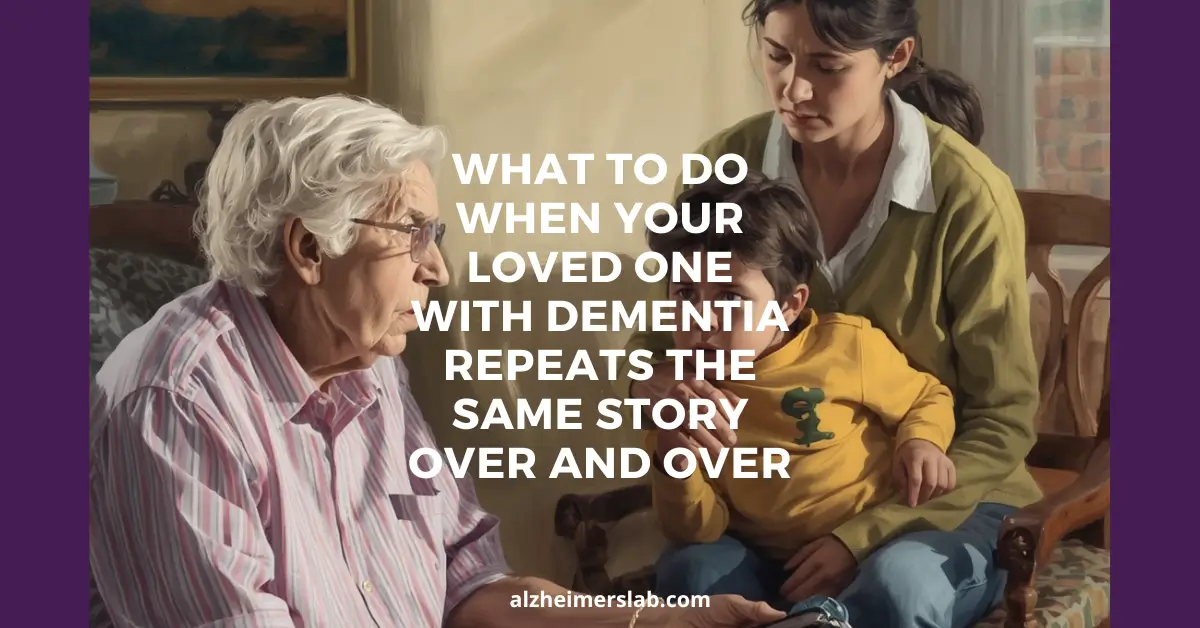
Why People With Dementia Repeat the Same Story
Caring for someone with dementia changes how everyday conversations work. You may hear the same story repeated five, ten, or even twenty times in a single day. At first, it might seem harmless. Over time, though, it can become exhausting, confusing, and emotionally draining.
If you are dealing with dementia repetition or repeating stories in Alzheimer’s, you are not alone. I want to walk you through why this happens and what you can actually do about it in a calm, practical way. You will find simple techniques that respect your loved one while also protecting your own mental energy.
Why Repetition Happens (Caregiver Perspective)
When your loved one repeats the same story or question, it is not intentional. It is not stubbornness. It is not something they are doing to test your patience.
Repetition happens because dementia affects short-term memory. The brain loses its ability to store and retrieve recent information. So even if you just answered a question, that answer may not stay in their memory for more than a few seconds or minutes.
In addition, familiar stories from the past often remain intact longer. That is why many people with dementia repeat old memories. Those stories feel safe, recognizable, and comforting.
There is also another layer to this. Repetitive behavior in dementia can come from anxiety. When someone feels unsure or disoriented, they may repeat a question to feel grounded again.
Research supports this pattern. Memory loss and behavioral repetition are common in Alzheimer’s disease and related conditions (National Institute on Aging).
So when you hear the same story again, what you are really hearing is:
- A memory loop that cannot close
- A need for reassurance
- A brain trying to make sense of the present
Understanding this changes how you respond.
The Emotional Impact On You (And Why It Matters)
Let me be direct. This part is hard.
When you hear the same question repeatedly, it can feel frustrating. You might feel irritated, guilty for feeling irritated, and then mentally exhausted. Over time, it can even make you withdraw from conversation.
That emotional reaction is normal. You are human.
But here is something important to understand: your response affects the situation more than the repetition itself.
If you respond with visible frustration, your loved one may pick up on that emotional tone even if they do not understand why. That can increase anxiety, which often leads to even more repetition.
So while you cannot stop the behavior completely, you can reduce how stressful it feels—for both of you.
The goal is not perfection. The goal is steadiness.
Technique #1: Validation Instead Of Correction
Your instinct might be to correct. You may say, “You already told me that,” or “I just answered your question.”
However, correction rarely works. In fact, it can create confusion or embarrassment.
Instead, try validation.
Validation means you acknowledge the feeling behind what they are saying, rather than focusing on the accuracy or repetition.
For example:
- Instead of: “You told me this already”
- Try: “That sounds like it was a really special moment for you”
If they ask the same question repeatedly:
- Instead of: “I already answered that”
- Try: “I understand why you’re asking. Let me help you with that again”
This approach reduces anxiety. It also keeps the interaction calm and respectful.
Over time, you will notice that validation lowers emotional tension, even if the repetition continues.
Technique #2: Redirection And Distraction
Redirection is one of the most effective tools for dealing with repetitive dementia behavior.
Once you respond to the question or story, gently guide the conversation somewhere else.
You can say:
- “That reminds me, would you like some tea?”
- “Let’s look at this photo together”
- “Can you help me with something for a minute?”
The key is to shift attention without making it obvious.
Activities that work well:
- Folding clothes
- Looking through photo albums
- Listening to familiar music
- Simple household tasks
Distraction works because it gives the brain something new to focus on. Since attention span is often limited in dementia, even a small shift can break the repetition cycle temporarily.
Technique #3: The Gentle Lie (When It’s OK)
This may feel uncomfortable at first, but sometimes a gentle lie—or what many call a “therapeutic fib”—is the kindest option.
If your loved one keeps asking about something that causes distress, telling the literal truth may not help.
For example:
If they repeatedly ask about someone who has passed away, reminding them of the loss each time can cause repeated grief.
Instead, you might say:
- “They’re not here right now, but they’re okay”
- “They’ll be back later”
This is not about deception. It is about reducing emotional pain.
According to dementia care guidelines, therapeutic fibbing can be appropriate when it prevents distress and improves well-being (Alzheimer’s Association).
Use this technique carefully. The goal is always comfort, not convenience.
Technique #4: Written Reminders And Notes
When someone repeatedly asks the same question, written reminders can sometimes help.
For example:
- A note on the table: “Lunch is at 1 PM”
- A whiteboard: “Your daughter will visit this evening”
- A simple calendar with clear labels
These visual cues act as external memory support.
However, this method works best in the earlier stages of dementia. As the condition progresses, the ability to read and understand written information may decline.
Even then, visual prompts like pictures or symbols can still be useful.
Keep it simple. Avoid clutter. Too much information can increase confusion.
Technique #5: Recording Your Answers
If your loved one asks the same question many times a day, you can try recording your answer.
Use your phone or a small recording device. Record a calm, reassuring message in your own voice.
For example:
“Hi, everything is okay. You already had your lunch. I’ll be here with you today.”
When they ask the question again, you can play the recording.
This works because:
- Familiar voices are comforting
- It reduces the need for repeated verbal responses from you
- It creates consistency in reassurance
Not everyone responds to this method, but when it works, it can reduce caregiver fatigue significantly.
Technique #6: Humor And Lightness
This one depends on your relationship and your loved one’s personality.
Sometimes, a little humor can ease repetition.
For example:
If they repeat a story, you might say with a smile:
“I think this story is becoming my favorite. Tell me one more time.”
Or gently play along:
“That must be an important story—it keeps coming back to visit us”
The goal is not to make fun of them. It is to keep the moment light instead of tense.
Humor can break frustration and help you stay emotionally balanced.
When Repetition Increases (Disease Progression)
Repetition often becomes more frequent as dementia progresses.
This happens because:
- Short-term memory continues to decline
- Awareness of repetition decreases
- Anxiety or confusion may increase
At later stages, repetitive questions may turn into repetitive actions or phrases.
It is important to adjust your expectations.
You are not trying to stop the behavior completely. You are learning how to respond in a way that keeps both of you calm.
If repetition suddenly increases, it is also worth checking for triggers:
- Changes in routine
- New environments
- Physical discomfort
- Infection or illness
Sometimes, increased repetition is a sign that something else is wrong.
Taking Breaks And Self-Care
Let me say this clearly: you cannot handle repetitive dementia behavior well if you are exhausted.
Caregiver burnout is real. And repetition is one of the biggest contributors to mental fatigue.
So you need breaks.
Even short ones:
- Step into another room for a few minutes
- Ask a family member to step in
- Use respite care services if available
You also need emotional outlets:
- Talk to someone who understands caregiving
- Write down your thoughts
- Take a walk when possible
Taking care of yourself is not optional. It directly affects how you respond to your loved one.
When you are calmer, your responses become softer. And that changes the entire interaction.
What NOT To Do (Avoid These Mistakes)
Some reactions can unintentionally make repetition worse.
Avoid these:
1. Arguing or correcting repeatedly
This leads to frustration on both sides and does not improve memory.
2. Showing visible irritation
Even if they cannot understand your words, they can sense your tone.
3. Ignoring completely
Silence can increase anxiety and lead to more repeated questions.
4. Giving long explanations
Complex answers are hard to process. Keep responses short and clear.
5. Taking it personally
This is not about you. It is a symptom of the disease.
When you avoid these mistakes, you create a calmer environment. That alone can reduce how intense the repetition feels.
Final Thoughts
When your loved one with dementia repeats the same story over and over, it can feel like you are stuck in a loop. But that loop is not meaningless.
It is a signal. A need. A reflection of how their brain is changing.
You cannot stop dementia repetition completely. But you can change how you respond to it.
And that changes everything.
If you stay patient, use simple techniques, and take care of yourself, you will find that these moments become easier to manage—even if they never fully go away.
